Confirmations of the Greber Book
I have decided to add a page documenting the personal experiences of a scientist whose training in Physics at The University of Arizona initially made him skeptical of the supernatural until he began to experience the supernatural for himself. He asked God for evidence and confirmation of the authenticity and genuineness of the Greber book that he received from his sister around 1977. I have asked him personally if I could post some of his recollections regarding these personal experiences that he took to be answers to prayers regarding the truth of the Greber book. He responded that he did not mind my sharing with you, the seeker, his experiences as recorded by him from memory.
Confirmations #1, The Smile
When a friend gave me the Greber book in 1977, I was totally captivated at finding the first cogent explanations I had ever seen of the basic questions of Christianity and of spirit phenomena. For the first three years of having the book, I put one thousand hours per year studying it, along with ancient writings, expanded translations, and many other references, while looking for confirmation of the book’s claims. I found a few minor errors in the text, probably due to Greber’s English language inaccuracies or due to translator inaccuracies, but nothing that would disqualify the book. It was such a powerful book that I knew I had to share it, but always in my mind was the injunction of James 3:1, “Let not many of you become teachers, my brethren, knowing that as such we shall incur a stricter judgment.” (New Amer. Std.) (Translations vary.) It is a serious proposition, a weight that every clergyman’s shoulders bear, to lead other people into believing something that might not be true. This is an issue that I wrestled with many times. How could the claims of the Greber book be confirmed?
I was struggling with this question one hot summer day while riding down the highway with my son of about ten years old. The day was one of those very rare days in which the sky is perfectly clear with no trace of haze, smog, or clouds. The color was a deep clear blue, much like what is seen high in the Colorado Rocky Mountains. I was gripping the steering wheel with both hands and staring straight ahead pondering weighty questions about Christianity, while my young son was sitting on the forward edge of the passenger seat looking at the countryside and enjoying the scenery. There were many complications to rectify. The issues involved spirits, Christianity, physics, quantum theory, and so on, far too much for me to resolve. My silent prayers for clarification while driving along became pretty intense. I was asking God whether the Greber book was indeed true. Who was the spirit that spoke to him through the boy? And on and on.
My frustration with God grew and grew the more I mused. I couldn’t figure out these questions. In exasperation, I complained that we have errors in our Scriptures, we have faulty documents, we have limited intelligence and questionable reasoning ability, and so on, and, I might add, You are not being much help. It just isn’t fair, I complained. How can You, God, expect us mere ignorant humans to figure out the truth amidst the chaos of opinions we find on this planet, when You didn’t give us the clear facts and the mental equipment to do so? And why do You have to be so obscure and subtle all the time? Sir, I am just a mortal, and not a very special one at that. I can’t figure this all out. Can’t You do any better? I just don’t get it. I’m pretty dumb. Can’t You be a little more obvious, Sir? “I need a neon sign in the sky”, I chided our Lord.
Little Doug, who was sitting on the front edge of his seat, suddenly leaned forward, looking at the sky directly above us, and exclaimed, “Daddy, look at that!” I couldn’t see directly overhead while driving, so I quickly wheeled off the highway and stopped on the shoulder. I leaned forward and peered straight upward through the windshield and spied a small design, not much bigger than a full moon, hanging high in the sky. It was composed of a little pattern of snowy white vapor or cloud. The bottom part of the pattern was a capital letter “C” lying on its back with the open side upward, or a parenthesis doing that same thing, while above that arc hovered two snow white splotches side by side. I could not help but rejoice and laugh at the same time. High above us in the Colorado blue sky was a perfectly drawn “Smiley Face”. It was the only thing in the entire sky. We watched in amazement as the entire pattern quickly evaporated in about fifteen seconds, leaving only the beautiful, pristine, empty blue sky.
No skywriters have been seen in this area for at least fifty years. At any rate, an airplane cannot turn at such a short radius to have made that design. I don’t know where the Smiley Face came from, but I know an airplane did not make it. This was not the neon sign in the sky that I had sarcastically asked for: it was better. My son and I got back on the highway and picked up speed, my heart full of praise and gratitude to our God and to the Spirits, who apparently have a good sense of humor.
During the next few years, numerous confirmations of the Greber book were given. Eventually I decided that the evidence was so great that I would “presume to be a teacher” of what the book claimed to be the truth. To that end, I introduced a college course in which the Greber book was one of the required texts.

Confirmations #2, Out of Body in Class
The Bible makes several mentions of events which are apparently references to an out-of-body-experience (sometimes abbreviated in current literature as OBE or OOBE). As an example, we read, “For I, on my part, though absent in body but present in spirit, have already judged him who has so committed this, as though I were present.” (I Cor 5:3, NAS) Contrary to the usual theological interpretations, Paul seems to be claiming that he was able to leave his physical body, and, as a spirit (in his spirit body) he had looked in on the Corinthians. Later on, when he could be with them in his physical body, he planned to pass judgment. Another example occurs in Revelation where John writes, “I was in the spirit on the Lord’s day …” (Rev 1:10). This is a clear and explicit reference to his being in the state that we would call out-of-body, the language used simply contrasting this state with that of being in the physical body. There are other Bible verses that suggest the same capability by other Prophets or Apostles. But is this understanding true? Can people go out of their own bodies at times?
There are some experimental results that suggest that out-of-body experiences are valid. The New Ager belief in astral travel is simply another name for this phenomenon, as is “Remote Viewing” as practiced by the U.S. Army Intelligence Corps. But, how conclusive is the evidence?
In order for me to accept the truth of this, or other, paranormal experiences, and to assume the responsibility entailed by passing them on to others as the truth, I require a claim to meet the following four criteria.
- The claim must be consistent with Scripture, as reasonably translated, extended and interpreted.
- The claim must be consistent with science, especially quantum physics, as reasonably extended and interpreted.
- The claim must be intuitively comfortable, carrying with it a certain inner knowing and feeling of rightness and truth.
- And finally, the claim must be confirmed somehow, to some degree, by Spirit, without too much interpretation or wishful thinking by the interpreter.
If these criteria are met, then we have about as much evidence to back up the claim as a person is likely to get while on earth. At that point, I would dare to teach it, always bearing in mind the warning, “Let not many presume to be teachers, for theirs is a stricter judgment” (James 3:1).
The fourth criterion cannot be met by man, but can only be satisfied by the Spirit in accordance with the promise, “Inquire of Me, saith the Lord, and I will show you great and mighty things which you did not know,” (Jer 33:3). And so I inquired.
One day I was teaching an astronomy class and drawing a diagram of the solar system on the board at the front of the classroom. I was busily explaining planetary orbits with no thought of metaphysics. From behind me I recognized the voice of a student who wanted to ask a question. I turned around to face the class, saw his upraised hand and said, “Yes, Mr. Alford, what is your question?” He replied, “Dr. Scarborough, what do you think about God?”
Nobody had ever asked me this question before. I had spent the first half of my life grappling with that very question and had only recently concluded that God was indeed real. Yet I had no idea how to field the question. I paced to one end of the large laboratory desk at the front of the room, then turned and paced back to the other end, looking down at the floor the whole time trying to formulate and answer. I was amused by my incompetence, and jokingly said to myself, “Help, help.” Perhaps this was a prayer, although I wasn’t serious about it. I have no idea. All I know is that an instant later I was floating out of my physical body, near the ceiling of the classroom off the right hand side of my physical body and a foot or so behind it. I had no idea how I got there. Then the physical body began to speak.
From my vantage point near the ceiling I listened to the most clear and beautiful explanation I had ever heard of why there was obviously a God. Anybody should be able to see that there was. I marveled at the clarity of the explanation and the airtight logic, thinking, “Yes, wow! I never thought of it like that!” It made perfect sense.
From my scenic overlook near the ceiling I could watch not only my own physical body but the classroom full of thirty students. Several of them had expressions on their faces that a teacher lives for, those rare “Aha! moments”, when something is making so much sense to the listeners that they instantly have a deep realization of why it is true. The students’ mouths were open with slight smiles, their eyes were widened and alert, and their heads were slightly and involuntarily nodding in agreement. It was a powerful and beautiful moment. The Spirit took over on behalf of the class when I was unable to deal with the question. I especially watched Mr. Alford, the student who had asked the question. The answer seemed to ring true in his soul.
The voice from my body was mine. The vocal cords were mine. The accent was mine. The answer was not mine. It was something that I didn’t even know. When the Spirit was done with its brief explanation, I was suddenly back in my physical body, perhaps like a stretched rubber band had snapped me back into it. What was I supposed to do then, say “Guess what just happened to me?” No, I was stunned by the unexpected experience and didn’t know quite what to do. I turned back toward the blackboard and finished drawing planetary orbits. Nobody in the room knew what had happened except for me and the Spirit. I didn’t want to take credit for the fabulous explanation, but what could I say?
The result of this experience was that the class got a powerful blessing and I got my confirmation that out-of-body experiences are in fact real. They really can happen. They are simply exceedingly rare. Certainly I do not have the ability to go out of my physical body voluntarily. I am just an ordinary person, not a mystic, psychic, prophet, or apostle.
This particular student and I developed a sort of father-son relationship. He spent quite a few nights eating and sleeping in our house until he graduated and moved to the Pacific Northwest. We are still good friends to this day some thirty years later, although he now lives on the opposite side of the country. A few years after the event, I told my student what had happened that day in astronomy class. He remembered the event vividly, but, unfortunately, neither of us could recall a single word of the Spirit’s explanation.
Although of the message had been lost, my student remarked that the answer given in class had been a life-changing moment for him and had redirected his life. And I didn’t do it. All the praise and all the credit go to God, Who definitely exists.
Confirmations #3, The Frozen Devil
According to the Bible, human spirits in their spirit bodies can sometimes leave their physical bodies and travel to other locations. Although this claim is usually overlooked by expositors, it is an ability that the Apostle Paul claimed to have. He wrote that he had visited the Corinthians “in spirit” and would later be with them in the physical body (I Cor 5:3). He made the same claim to the Colossians, “For though I am absent in body, I am with you in spirit, and it is a joy to note your steadiness and the solid front of your faith in Christ” (Col 2:5). It is important to note the Paul did not simply claim to be thinking about those people: he claimed to actually be there. The idiom “to be with you in spirit” in modern English expresses merely the sentiment of thinking about someone who is not present. However, this idiom did not exist in the Greek language used by Paul. The word “spirit” is “never used in the New Testament of temper or disposition” according to Vincent*. Finally, John explicitly states in Revelation that he was “in the spirit on the Lord’s day” when he received his revelation. This expression, in the language of that day, explicitly contrasted him with being in the physical body. Nevertheless, after our intellectual studies lead us to the conclusion that out-of-body travel is possible on rare occasions, it would still be profitable if the Spirit would furnish first-hand evidence.
This experiential evidence was granted to me one day as I was teaching an astronomy class and was faced with a question about God that I could not answer satisfactorily. I was removed from my physical body while the Spirit took over that body and made the reply. I hovered near the ceiling and listened along with the class. This event has previously been described in Confirmations #2, Out of Body in Class.
Afterwards, I began to study dissociative states and other psychological topics, looking for a possible worldly explanation of that situation, no matter how bizarre and unlikely. I could not find one. Nevertheless, always clinging to “Inquire of Me, saith the Lord, and I will show you great and mighty things which you did not know” (Jer 33:3), I asked for confirmation from above that I had truly had an out of body experience.
As time went on, it happened one day that an old and dear friend from high school years phoned me at home from Arlington, Virginia. He said that on the previous day he had been in New York City on business and had accidentally run into one of his former girlfriends from many years earlier. Accidentally running into a particular person in a city of millions? Right away my ears perked up. That encounter sounded like a “cosmic coincidence” contrived by Spirit for some other purpose. My good friend and his former girlfriend, Amy, ate a brief business lunch and caught up on the events in their respective lives. Toward the end of the luncheon, Amy told of a strange occurrence that had happened two weeks earlier. This is her story.
Amy and her husband, Leo, lived in a small town in Pennsylvania, where Leo worked as an automobile mechanic. Neither of them had any particular religious beliefs, let alone any interest in the paranormal or metaphysical. Leo only believed in what he could hold in his hands. On that morning, two weeks earlier, Leo fell asleep in his large chair at home and did not respond when Amy called to him. She called his name several times as she tried unsuccessfully to awaken him. She was becoming anxious and alarmed when Leo suddenly awakened. He looked at Amy and with awe said, “Guess what just happened to me!”
Leo said that he had just been “taken” – he didn’t know how – to some guy’s office down in Mississippi. The guy was sitting at his desk writing and that he was a scholar of some sort. The office had bookcases full of books on all the walls. The man was tall and thin and his name was Tony. (This took place thirty years and fifty pounds ago!) That was me all right. He even had the name right. He was standing in front of my desk looking at me. He said I looked at him and told him how to solve a particular marriage problem he and Amy were having.
I instantly recalled that, one morning two weeks earlier, I had been sitting at my desk busily scribbling notes and calculations in preparation for teaching a physics class, when the solution to a certain marriage problem flooded over me with such clarity and warm feelings that it interrupted my physics writings. The idea was full blown, perfectly simple, and beautifully expressed. I love how the Spirit does that. I was so pleased by the realization that I looked up at a space across from my desk and smiled that direction in pleasure as I relived the explanation in my mind. I did not see Leo, although that is where he said he was standing. Nor did I expressly know that the answer had just come from Spirit. It simply felt positive and unnatural. Nevertheless, my memory exactly matches Leo’s recollection.
As Leo was finishing his story, he became puzzled and added that there was one thing he didn’t understand. He said there was a small statue on a bookcase shelf behind where I was sitting. In the corner of my office was an object he struggled to describe, something that looked like a statue of a “frozen Satan”, in his words. I don’t have any statues of Satan, frozen or otherwise. I asked my friend to check it out with Leo. Yes, the answer came back, it was a small statuette of a “frozen devil” of some kind. Puzzled, I left my home and drove to my office to check out what he might have seen. On the way, I was imagining an orange-eyed devil whose skin was frozen to a deathly gray, even his red cape being chilled to a maroon color. What sort of demonic and grotesque entity could it be? I opened the office door and clicked the light on. Staring at the corner shelf of my office I saw what Leo had seen. If you are Pennsylvanian and out-of-body for the first time, and you have never been south of the Mason-Dixon line, how would you describe a Mississippi State University Bulldog?
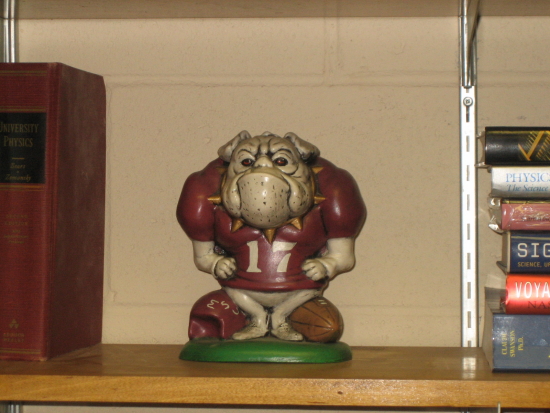

I could never have anticipated such a demonstration of out-of-body travel, which confirmed the experience that had happened in class. My thanks and deepest gratitude to God and the Spirits who arranged this confirmation of the reality of out-of-body experiences. Thanks to All!
*Vincent, Marvin R., Word Studies in the New Testament, Vol. III, The Epistles of Paul.
Confirmations #4, The Question
There were three times in the space of about a year when different students approached me and asked the identical question, “What do you think about God?” I have already written in a previous article (Confirmations #2) about the time when a student interrupted an astronomy lecture to ask me that question. I was taken out of body while the Spirit used my body to answer the question for the class. One of the meanings that I personally attached to that amazing experience was that I had only recently committed my total self to God, after He had demonstrated His existence to my satisfaction, and that I was now expected to get into the battle right away and take a stand. No sitting on the sidelines.
A few months after this student had stumped the professor, I had another experience very much like the first one. As I was walking down the hallway, headed to my office after the ten o’clock class had ended, a student approached from the other direction. There was, oddly, no one else in the hall. He walked right up in front of me and stood closer than people usual do. We said hello. He looked directly into my eyes. Then he asked, “Dr. Scarborough, what do you think about God?”
In the months after the first student had posed that question, I had done a lot of studying and thinking about it. I had researched the subject merely for my own personal satisfaction, having no inkling whatever that another person might benefit from my studies. By the time my student, Bart, asked me that same profound question, I was loaded with information and ready to respond. However, I had overlooked one important thing: how to answer. As a teacher, one learns to adapt answers to the comprehension and experience levels of the student. The explanations in physics class must typically be watered down, a bit superficial, and simplified by means of analogies. Such is the art of teaching. Like the Apostle Paul wrote, he fed his followers meat at times, but mostly milk. I overlooked this strategy with Bart. He had already flunked my physics class twice and was doing poorly in it on his third attempt. The question caught me off guard and I didn’t think quickly enough to formulate a fitting answer for him.
I was about to overwhelm this young man with the standard theological jargon, words like heuristic, exegetical, ontological, blah blah blah and so on. What a mistake that barrage of big words would have been. What a terribly inappropriate and useless answer for Bart. He could not have found those abstractions to be meaningful.
When I opened my mouth to speak and my lungs began to force air out to form words, I said, “Well, Bart, I think …”. That’s as far as I got. A cold chill rushed down my scalp and over my back, causing the hair on my neck to stand on end. At the same time, I felt a slight electrical tingle all over my body. The surge of energy seemed, figuratively, to almost lift me off the floor. It was not just one brief jolt of energy. On the contrary, it remained palpable throughout the subsequent brief conversation with Bart.
As I tried to speak, I felt some strange force twisting and shaping my lips, tongue and throat. This is difficult to describe, but my entire vocal apparatus was taken over quite beyond my control, although I had not been taken out of my body. Instead, I was inside it, but certain muscles in my mouth and throat had simply been overpowered by a force greater than me. My voice formed words that I did not intend to say. The words that came out were simple; the sentences were short. I was thinking, somewhat amused, “But that’s not what I meant to say. That’s not quite right,” but it was right for Bart. He asked another question. Again, I had no control over the answer. My job was to blow air out with my lungs. That was my only role in the encounter, and I suppose I did that pretty well, but a higher power had total control of my vocal apparatus and answered Bart’s questions beautifully. After another couple of questions from Bart, and a couple more simple answers customized personally for him by the Spirit, the conversation ended.
The chill, the goose bumps, and the electrical tingling all stopped abruptly. I was back in control of my speech organs again. Bart’s face, close in front of mine, seemed energized. His cheeks had turned rosy and his eyes had become bright and damp. With much feeling, he said, “Thank you, Dr. Scarborough, for what you’ve just said”. I mumbled something lame like, “You’re welcome”, and we parted company. I couldn’t possible tell him that I had not personally said anything at all. I dared not undo any of the blessing he had just received by tampering with it.
I could never remember the customized answers that Bart received, but they were obviously perfectly expressed for Bart. He received his gift. And I, on the other hand, had been granted a demonstration of still another way by which the spirit can speak through a person. This experience, along with the previous out-of-body event in astronomy class, had confirmed to me personally two of the several ways in which the Spirit can speak in tongues, in this case the tongue being deep-southern English. And the listener will never know it. There is no obvious way he can tell, unless the Spirit uses a foreign language “as a sign to the unbeliever” (I Cor 14:22).
In this vein, I had caught on that I needed to skip the deep theological responses and to answer as I would to a question in physics class. Namely, simplify, simplify, simplify. The chance to use this realization happened a couple of months later with another student: David.
David was on the university basketball team. He was a tall, gangly black kid with a good jump shot. We had gotten to be pals outside of class. On several occasions, David had dropped by my home just to talk. We talked about classes, girls, basketball, girls, race relations, girls, and other matters that interested him.
One day David was coming down the stairs in the center of the science building while I was headed up. We met in the middle, greeted each other, and paused to chit-chat. Leaning against the guard rail, David unexpectedly asked me the same profound question I had heard twice before. He said, “Dr. Scarborough, what do you think about God.” It was almost as if this encounter had been staged, as the question was phrased exactly as it had been on the two prior occasions. A wave of excited anticipation came over me as I prepared to answer. Would this be an out-of-body experience? Would the Spirit take over my vocal apparatus? What amazing thing was about to happen?
I gave him a short and simple answer to part of his question. At least I did that part right. He seemed unimpressed. He continued with another related question. I fielded it as best I could. Where was the help? As I gave my best answer to still another question, I noticed that David’s eyes were straying the entire time to something down the empty hallway. He was obviously bored and inattentive. Without the aid of the Spirit, my answers had no effect at all.
The lesson was driven home to me one more time that, without God’s help, we are often pretty ineffectual beings.
Confirmations #5, From the Mouths of Babes
In researching the Greber book’s claims and searching for confirmation of them, I was given another confirmation of the existence of numerous higher spheres. In considering this event, it is important to note that I had intentionally not mentioned any of that book’s ideas in front of my children. Their souls were far too important to me to let them be taught ideas which might be wrong. Nevertheless, my ten-year-old son came up with something on his own.
The Bible contains numerous hints that there are a multiplicity of higher dimensions of space-time*, or “quantum levels”, in physics jargon. Paul was a “Pharisee of Pharisees”, as he described himself, and they believed in seven heavens. Paul himself claimed that he had been taken to the third heaven on one occasion. Quantum physics predicts that, if there is indeed a life force, then there would be an unknown number of higher levels of that force, more popularly described as other space-time dimensions. All-in-all, the multiple-dimensional universe seems highly likely.
One night my son approached me while I was sitting on the sofa reading a book. He had invented an idea about the higher heavens and wanted to explain it to me. Of course I wanted to hear it. He knelt on the floor, put a sheet of paper on a lap board, and proceeded to draw a sketch showing concentric semicircles representing the higher dimensions that we, in our collective ignorance, simply call “Heaven”. He explained how spirits can move progressively higher as they improve, eventually reaching the dimension occupied by the spirits we call angels. I was rather amazed at how closely his ideas resembled those propounded by the Spirit to Pastor Greber. I took this as a confirmation of his book. Yet I wanted still further confirmation of this explanation.
As time passed, I was traveling one day with my youngest daughter, Laurel, to a nearby town about fifty miles away. She sat in the passenger seat of my little Subaru while I drove along in the summer heat, pondering and wrestling with the problem of multiple higher dimensions. For most of the trip we rode like this, neither of us speaking. As usual, I was gripping the steering wheel with both hands and staring straight ahead trying to figure out the truth about multiple heavens. Laurel had just turned either four or three years of age: I cannot remember which one. As we left on the trip, she had reclined her passenger seat and taken her shoes off. Little by little her socks followed. I think that perhaps she counted her toes a few times, humming or singing all the way, doing the things little children do to pass the time. I paid no attention to her. Heavier matters occupied my mind. We rode on like this for about forty minutes, one of us analyzing and the other one humming. Then she went silent. Pulling the recline control of her seat, she popped the seat into its upright position and leaned over to talk to me. Her little face was right in front of mine and she looked directly into my eyes. With the sweet smile of a little child, she said, “Daddy, you don’t understand about the heavens, do you?”
That’s exactly what I had been trying to figure out. I looked at her speechlessly, but managed to say, “No, Laurel, what do you think?” She gave me a clear, brief exposition, in simple terms, of higher heavens. She made it sound so simple, and it actually is. I was astounded. Thank you, Lord, for an explanation of your works from a child just barely three or four years old. This event confirmed an earlier explanation given through my son.
During that time period of the early 80’s, I had either five or six occasions when a small child would come up to me and explain some point of doctrine I had been concerned about. Only two of the children were mine. Some were strangers. I deeply regret that I did not keep a diary and log each response. Except for my own two children, I have long since forgotten who the various children were and what they said. Nevertheless, I was shown abundant evidence confirming that the Spirit can put ideas into the minds of little children, if need be, to educate confused adults.
Confirmations #6, The Ouija Board
The Bible mentions several ways in which servants of God contacted Him via means that would appear unholy to us today. Joseph used a silver cup to divine the future and all of Egypt knew it, according to his story, but it was not explained how he used the cup. Others cast lots. Some used the Urim and the Thummin, but scholars have been unable to figure out what they were. The most famous device was surely the breastplate of judgment, a gold object inlaid with twelve precious stones. It is reminiscent of an what an early Ouija Board might have looked like, except that it was made exactly according to the instructions dictated from on high, not manufactured by a toy company. The purpose of it, according to Scripture, was to enable the user to hear from Above.
There was a period of time a number of years ago when Ouija Boards became a fad on college campuses in the deep South. I even allowed one to be brought to my class so that we could demonstrate that nothing would come of it. We darkened the room, lit a couple of candles, and allowed several volunteers to seat themselves around the board and go through the routine of sliding the pointer around. However, instead of the usual questions that people ask the board to answer, I asked specific, testable questions. The alleged spirit had to give his name, date of death, location of his grave, name of his last employer, Social Security Number, and so on. During the next few days, I checked out every one of the answers, and, as expected, not a single one of them was true. Clearly, no real spirit was in charge of the board (unless it was a liar). Point made. But the question still remained unanswered whether it is possible for a spirit to use the board.
A local nurse told me about a time years before when she had been baby-sitting a grammar school child and they decided to play the Ouija Board to pass the time. They sat on the floor and went through the procedure. The pointer moved, as it always does, because the participants are, consciously or unconsciously, moving it. After a while, they felt a cold chill sweep over them. They were no longer able to move. While they sat paralyzed, the pointer spelled out some kind of message on the board with nobody touching it. It was a very frightening time for both of them. She vowed to never again touch a Ouija Board.
On another occasion, on a cold, rainy, Saturday night in winter, I received a call from a student in one of the dormitories on the college campus. He said that a group of students were in the lobby of the dorm playing with a Ouija Board when one of them became possessed by a spirit. Would I please come down and help them?
At that moment, I was in the midst of eating a late supper with my family and a guest. The situation didn’t sound too serious, so I gave him some instructions and rejoined the family. Before I had made it through dessert, he phoned again. The procedure I had suggested to him hadn’t worked. He was scared. Would I please come down to the school and help them: Of course I said yes. These students assumed that I would know what to do, although I did not. I am not an exorcist. I had never dealt with a case like this. The students seemed to think I might have some special powers, which I definitely do not have. God has the power. In any event, my guest and I drove to the school.
As I entered the dormitory lobby, I saw fifteen or so students standing in an empty room connected to the main lobby. All of the frightened youngsters were standing around the edges of the room with their backs to the wall except for one. Stephanie sat cross-legged and alone on the carpet in the middle of the room. They explained the situation to me.
It seems that several of them had been sitting on the floor playing with a Ouija Board. They were not taking it seriously. It was simply a parlor game with which to amuse themselves on a blustery Saturday night. The board spelled out this and that for them, but they assumed that somebody was secretly moving the pointer. Then the board’s responses became a bit more serious. They asked who it was. The board spelled out “Ben.” It proceeded to tell them that Ben wanted to be in one of them. That is when they became fearful.
Stephanie had been feeling playful and bold, so she said he could be in her. According to the witnesses, as soon as she said that, her face blushed red as though sunburned, and her medium length straight, brown hair stood straight out from her head, as seen in the traditional science book photograph of a girl with her hand on a static electricity generator producing high voltage. She fell backwards onto the carpet, her body quite out of control. The voice coming from her was no longer hers. It was the high pitched voice of a young boy. The voice said it was Ben.
The other participants, those who were not already backed against the wall, laid her out straight on her back. They reported that her body then started to slide slowly across the carpet and they couldn’t stop it. Two kids held her wrists and another two held her ankles, while she slid across the floor, pulling all four students with her. The slide finally stopped when her head bumped into the wall.
With this background information, I approached Stephanie. She had a blank, far-away look on her face. I said I wanted to talk to Ben. That was no problem, as his voice was the only voice which replied. I didn’t know if this was really a spirit named Ben or whether Stephanie was having a schizoid episode or some other psychological problem. It doesn’t seem to matter very much. In either case, it helps to talk to that personality as though it is a real entity. And so I did, not being at all sure that what I was doing would help.
I conversed briefly with Ben. I explained to him that the body belonged to Stephanie and that he couldn’t stay in it. He didn’t want to leave. He complained that he loved Stephanie and wanted to stay in her. I told him it was OK to love her, but that she owned the body and he was going to have to leave it. He protested. I told him that I was going to call a light to remove him from her.
Several of the students lining the walls were crying in their fear. Several others were praying. I placed my left hand on Stephanie’s hands, which were folded in her lap, and my right hand on her forehead and began to pray aloud. Ben complained and resisted all the way through the prayer. I’m pretty certain that I asked Christ to set her free and for His angels of light to come and remove Ben. The prayer was something very close to that. I had already warned Ben that a light was coming and that he would have to go with it.
At the end of this brief prayer, Stephanie’s body went limp and collapsed into my arms. The voice was hers once again. I held her while for about ten minutes while she sobbed and trembled before regaining enough composure to talk. She was aware of everything that had happened. She had heard Ben speaking with her vocal cords but had been unable to stop him. She had felt him occupying her body, but she had been powerless to stop him.
The boy who owned the Ouija Board broke it across his knee and threw it in the trash. I helped Stephanie stand up and took her outside for a walk, holding her steady like escorting a drunken friend. It was misting rain with near-freezing temperature, but I thought the walk would help her. We walked back and forth in front of the dorm briefly and then returned to the lobby. Her crying had ceased and she was shaken but seemed rational. The crisis was over. My guest and I returned to my home soon thereafter.
A couple of weeks later, I encountered Stephanie in McDonalds. I smiled and spoke to her and asked how she was doing. She had no idea who I was. Other students told me a few days later that Ben had been returning off and on and that Stephanie had become mentally disturbed and had left school.
One final note about Ouija Boards. I learned of two girls at another university who had been playing with a board and had apparently become possessed. They wound up in the psychiatric unit of a hospital. Another lady told of their own experiences when the pointer moved of its own volition without anyone touching it.
Any efforts toward contacting spirits without the sanction and protection of God’s Spirits are dangerous indeed, whether they are by Ouija Boards or by any other means. A participant in any such attempts risks having a spirit become attached to him that he cannot get rid of.
Confirmations #7, Missing Distance
The conference on metaphysical and paranormal experiences was scheduled to start on Saturday morning at Austin, Texas, a full 500-mile drive from my home. It was not possible to depart on the trip until I finished teaching a class at noon on Friday, so my wife and I knew we were going to have to push it pretty hard to get to Austin that night. We left as soon as possible after the class ended and drove as fast as the law allowed.
Somewhere along a state highway that night, we stopped at a convenience store to purchase a snack. It was an odd store. It was located on a slight rise a few yards off the highway and was an unusual circular design. The bottom half of the exterior walls was made of brick, the top half was covered with windows. The back of the circular store was bricked all the way from the ground to the roof. I pulled into the gravel parking lot, shut off the engine, and walked inside. At the checkout counter was a short, friendly older lady with abundant gray-white hair. I placed a 16-oz Mountain Dew soft drink and a package of eight peanut butter crackers on the counter and asked her how far it was to Austin. “It’s two hundred miles,” she answered without hesitating. Then she added, “It’s a good four hours from here.” She was obviously familiar with the countryside. The large electric clock on the wall, a Westclox, read 9:20. I compared it with my wristwatch, which also read 9:20. There seemed to be no way to make it to Austin that night so that we could attend the first presentation at the conference the next morning, but off we went.
Back on the road, my wife, Frances, and I shared the soft drink and the crackers. It was a beautiful night in early May, the temperature was perfect, and there was very little traffic on the state highway. A full moon was rising over my left shoulder breaking the darkness. Frances soon went to sleep as we breezed along making good time. After she had napped for a long time, we came across a large reflective green sign with white lettering on the right hand side of the road that read, “AUSTIN 20 MILES.” Excitedly, I awoke Frances with, “Frances, we’re going to make it!” If I had done the math, I would have realized that something was wrong with the timing. In any event, we cruised to our motel near the conference site in Austin and walked up to the check-in counter. The electric clock in the wall behind the desk clerk read 10:50 PM. The check-in desk was scheduled to close at eleven o’clock. We had ten minutes to spare and only one person in line ahead of us. Had we not arrived when we did, we would not have been able to stay there for the night.
Then it hit me: the times didn’t check out. From 9:20 until 10:50 is an hour and a half. How could we have covered 200 miles, “it’s a good four hours from here”, in that time? We would have had to average about 130 mph. In a state of bewilderment and with a feeling that something really strange was going on, I checked in and we went to our room and slept the night.
The next morning was Saturday, the day the meetings were to begin. After breakfast, I was walking across the parking lot toward the conference meeting room when I noticed the man who was the main speaker standing amid a small group of other fellows talking. I had brought him a copy of the Greber book as a gift and this seemed like an opportune time to present it to him. I walked up to the group. At a pause in their conversation, I extended my hand with the book in it toward the main speaker. A large German man was among the group. He was about fifty years old, over six feet tall, well-muscled, with thin gray hair on the sides of his head and with a bald pate. He reached out and slapped the book out of my hand. The book crashed to the concrete, with the fellow angrily barking in a strong German accent, “I know ziss buch. It is a fraud. Zat Greber man is a hoax und a liar!” and other strong words that I cannot recall. A couple of his friends restrained him. While they blocked him from approaching me again, he calmed down a little, and I picked up the Greber book and gave it to the speaker. In a few moments we all went inside.
Once inside, the man to whom I had just given the book opened the conference with the first presentation. As he was standing behind the podium on stage, the hostile fellow entered with two of his friends and sat down immediately in front of me. In that large sloping auditorium, I was looking down onto the top of his head as the speaker on stage began his presentation. Then the objector begin to tremble. His trembling grew into a full shaking. He jerked upright into a standing position and, with a wild look in his eyes, began bellowing something unintelligible at the speaker. He was not roaring in English or German. It was some other language, if it was a language at all. His outburst became uncontrollable. He collapsed onto the narrow floor area right in front of his seat and curled up into a fetal ball, all the while shaking and convulsing. His friends tried to help him uncoil and stand up, but he was too heavy and powerful for them. Others came to the rescue. By that time, the poor fellow had foam issuing from his mouth and was out of control. When he was finally helped up, his convulsing and bellowing had stopped and he had a dazed blank look in his eyes. He didn’t seem to know where he was. Helpers escorted him from the conference room where I think he was met by medical staff who took him away. That is the last we saw of him.
When the presentation was over and the audience was leaving the room, a sudden insight surged through me and I understood why we had magically arrived the previous night in time to witness these events. I had been looking for, and asking for, confirmations of the Greber book, and the experiences with the possessed man were the first of many confirmations granted me. If the lower forces were intent upon calling the book a fake and a fraud, and upon disparaging Pastor Greber and possessing their human instrument in the process, then that seemed to me to confirm, in a negative way, that what Greber had written was indeed true.
Yet the problem of the times and distances still stumped me. On the long drive home from the conference, my wife and I looked for the peculiar circular convenience store. I wanted to go back inside it and check it out. We never found it. It is hard to imagine how we might have missed spotting it, especially since we knew where it was and it was conspicuously unlike any other store. Its absence was puzzling. Even more puzzling was how we had apparently covered 200 miles in an hour-and-a-half on Friday night. That question baffled me for years, as I entertained every possible explanation I could come up with and never found one that worked.
Eventually I consulted a nationally-known hypnotherapist to see what kind of memory could be retrieved under hypnosis. The story that came out of me was, in summary, that the car containing my wife and me had been surrounded by an electric blue glow, then “beamed up” somehow by human entities with us inside it, and placed back down on the highway many miles farther along our journey. That would account for the missing distance, of course, but that story is hard to believe.
I am aware that stories which emerge under deep hypnosis are not necessarily true. There was no way I could either verify the story or prove it false. It is hard to know what to believe. And so, the mystery of the “missing distance” remains. But my interpretation of the whole sequence of events as a confirmation of the Greber writings seems to stand up.
Confirmations #8, The Spirit Speaks
Slight inaccuracies in the Greber book* are bothersome. Larger errors are even more troublesome. There were at least two glaring factual errors in the book. If the book is imperfect, then how many mistakes might it contain that a human would not know about?
When his spirit contact began, Pastor Greber was quite unprepared for the messages that were given to him. He did not believe that spirits communicated with mankind. After each session with the spirit, Pastor Greber had to recall it later and write down what he remembered. He soon began taking notes as best he could when the spirit spoke. Any person who has ever taken notes in class knows how imperfect that process can be. As a teacher, I had many examples where students took notes in my classes and later used their notes to claim I had said something that I would not have said in a million years. One wonders where they got those ideas: they said that’s what they heard in class. The recounting of an explanation from notes that were made during its telling is prone to errors.
Joseph Greber, one of Pastor Greber’s sons, recounted that his father eventually began using a secretary who could take shorthand. Even at that, the possibility of introducing errors in transcription is apparent. As far as Joseph knew, his father never employed a tape recorder. We must remember that the messages came in the early part of the 1900’s in rural Germany.
On one occasion in the 1980s, I was present at a prayer meeting during which a spirit spoke through a deep-trance medium. This was the same spirit who had materialized to that group some years earlier and announced that he would be speaking from time to time through a particular member of that group. As the spirit was familiar to the group, and had been subjected to the Biblical test of swearing that Jesus is Lord, his message was taken seriously. The reference here is to, “Beloved, do not believe every spirit, but test the spirits to see whether they are from God… every spirit that confesses that Jesus Christ has come in the flesh is from God … and every spirit that does not confess Jesus is not from God …” (excerpts from I John 4:1-3 NAS). On this occasion, the spirit was asked whether there needed to be corrections made to the Greber book or follow-up volumes to be written. The spirit replied that the book was pretty nearly free of imperfections as it stood, and that no further revisions or alterations were planned by the Spirits at that time. Then the spirit added, “There are two places, however, that are in error, but these would bother nobody but a scientist.” Of course, I was the only scientist present. The spirit then proceeded to point out exactly those two places that had bothered me for several years. The spirit said that they were due to Greber’s lack of understanding of the exact facts of those cases.
One of the mistakes occurs early in the book, where the author refers to the blood of a pregnant mother-to-be as circulating through the veins of the fetus. This is, of course, completely wrong. The fetus has its own blood supply that is not mixed with the mother’s. The fetus does receive nutrients from the mother, but not blood.
The second major mistake was just as conspicuous. Unfortunately, I have racked my brain and cannot find the error anywhere in my memory. At this late date, the passage of time has completely erased the erroneous passage from my memory. If any reader knows of a second glaring error, I would appreciate being reminded of it.
The end result of this prayer meeting was that the Spirit confirmed that Pastor Greber’s book is trustworthy and true, with the possible exception of slight inaccuracies of expression and translation that inevitably appear whenever humans attempt to recount an explanation they have heard.
*Johannes Greber, Communication with the Spirit World of God (1932). Several later editions exist with the title slightly altered by the addition of, Its Laws and Purpose.
Confirmations #9, The Sword
The weekly prayer/meditation sessions were held in our home in accordance with the instructions given in the Greber book. The room was a 20 ft x 20 ft room entirely paneled with natural western cedar. There were normally fifteen to twenty people participating. Sources of odic energy to be utilized by the spirits were placed in the room during the day of the meeting. Quiet recordings of hymns and other religious works were played in the room all day. At the evening meeting, the circle of worshippers had a scripture reading, sang, prayed, joined hands, then sat in the darkness and meditated, awaiting possible communication from above. On occasion, two or more people might report having had the same thought during this time. Sometimes there were other suggestions that guidance was being given. Usually it was simply a quiet and peaceful worship session.
On one occasion, however, a hole opened up in the darkness in front of me. This is difficult to describe: I will just call it a hole in the fabric of space. The entire room was totally dark except for a circle about two feet in diameter at arm’s length directly in front of me. I could look into the hole, a little like looking through a hole into another room. There was a person visible in the hole. I somehow knew the entity was a male, but I don’t know how I knew. He was dressed in a bright white robe which radiated a white aura like a halo, giving him a slightly fuzzy appearance. The angel was visible only from the hips to the shoulders. I could not see his neck, face, or legs. The robed being was simply presenting the scroll and the sword to me without gripping it.
The angel was facing me through the hole in space. His elbows were against his sides, as his hands were extended toward me with palms up. In his hands lay a gleaming sword that passed through the center of a scroll wrapped loosely around the blade about midway of its length. The robed being was simply presenting the scroll and the sword to me. The sword was the most beautiful sword I had ever seen. It had a straight double-edged blade with a magnificent glistening chrome or silver sheen to it. The hilt seemed to be gold and the handle of a darker material but trimmed in gold and silver. Nothing else was visible inside the circular hole in space: only the angel presenting the sword.
I stared in the darkness at this amazing sight. I noticed that I could see it whether my eyes were open or closed. It made no difference. Further, I could move my head left and right while peering into the hole and see that the image was three-dimensional. After a short but unhurried amount of time, the vision simply vanished into the darkness.
I somehow knew what the vision meant. The scroll represented the truth. The message was a confirmation that the Greber book and the Spirit’s explanations of the Bible were true. The robed messenger handing me the sword meant for me to fight for the truth, and at the same time it meant that the Spirit would fight with me and for me.
Later on, I looked up Biblical verses involving swords. There are several Biblical references to the “sword of the spirit”. For example, Ephesians contains a passage speaking of our fight against evil forces and negative spirits while in this life. In that context we are instructed to “take on the full armor of God” (Eph 6:13) and to “take up the helmet of salvation and the sword of the spirit, which is the word of God” (Eph 6:17).
For the first several years after I discovered the Greber book, an admonition had always been in the front of my mind: “Let not many of you become teachers, my brethren, knowing that as such we shall incur a stricter judgment” (James 3:1). I had not even passed along any of the information to my three children, as I did not want to implant something into those precious young minds that might be incorrect. However, now that the confirmations had been completed, I felt certain enough of the validity of that information to offer those truths to a college class. There seemed no realistic hope of that, however, as financial problems had forced the university to eliminate quite a few courses over the previous couple of years. Any new course had to be approved by various administrators and committees before it could eventually be offered. As a consequence, no new course was likely to be approved. At best, there was no hope of a new course being approved sooner than about two years. Although it seemed like a waste of time and effort, I nevertheless designed a course called “Science and Pseudoscience” which would cover a wide range of popular paranormal topics. We would start off by examining the possibility of life in the universe, of intelligent life, of space travel, UFOs and ETs, and channeling. The subject matter would then phase into Biblical events, near-death-experiences, miracles, and so on. The part of the Greber book dealing with the forces and laws of spirit communication would be part of the course. These and other topics would be presented in a grand jury format. Evidence both for and against each subject would be presented and the class would be the grand jury. People would be brought in to testify about the strange experiences they had. The students then had to decide for themselves what the truth was based on the evidence presented.
There was little chance such a course would ever be approved, but I was willing to try to teach it if the Spirit wanted me to. Such a college course seemed unlikely to survive in the deep South, especially in a sociologically and religiously conservative region like Mississippi. I submitted the outline for the course at Thanksgiving in 1983. By Christmas break the course had been approved, entered into the college catalogue, and placed on the schedule to be offered the next semester beginning in January. This was an amazing chain of events.
The class was offered every semester from spring of 1984 until fall of 2004. For twenty years, the classroom was filled to capacity with eager students. Over a dozen faculty and staff took the course. Some students did the unthinkable by taking the course two or even three times to see what new information might be presented. None of this seems humanly possible, but with God all things are possible. I am grateful for having had the opportunity to share this information with over two thousand young minds.
Confirmations #10, The Steppingstones
Untold thousands of books have been written about the Bible or the characters and stories in it. There seemed to be no need for another. Yet something was needed to bridge the distance between the usual orthodox Christian beliefs and the Greber* book. Many readers find that leap is too big for them to take. It seemed that something needed to be written that would help bridge that gap. And so, for quite a while I had felt the pull to write such a book, a book that would cast a life-line to the Christians who were locked into their doctrines but felt there was something more and could not find a path to further truth. Yet, I did not feel qualified to write such a book. Surely someone with better qualifications should undertake to lay stepping stones along the path for those pilgrims. I was unwilling to proceed with the writing based on nothing more than a recurrent pull to do so, and accordingly sought guidance from above.
During the fall semester at the small university in Mississippi where I taught, an interesting series of visitors occurred one week that seemed to be an answer to my prayers for guidance. Each of the five days of that work week, a different person showed up at my office and talked about supernatural and spiritual matters. Three of the people were complete strangers. The five people would simply pass by the open door of my office during the afternoon, pause and exchange greetings, then edge their way into the office and sit down. As we began to have a conversation, I knew from experience where it was leading. People would usually divulge strange spiritual or paranormal events, often saying they had never even told their wife or husband about it. For several years, similar conversations often culminated in the visitor asking if I had a book about those matters. I would then give them a copy of the Greber book. Over the years I gave away several hundred of the books, although not always under these exact circumstances. During the five days of visitations that fall, each person ended our session with the remark, “You should write a book about these things.” I thought, “OK, Lord, I suppose you’ve given me your answer.”
Life was far too busy for me to begin writing a book at that time. Weeks grew into months until finally the sense of urgency died away. Eventually I began to doubt the guidance. How was I to know the five people urging me to write were not just some odd coincidence? Before embarking on a writing project, I requested additional confirmation that I was supposed to do it.
The next summer I accepted a temporary position teaching at the University of Arizona in Tucson. I took advantage of that situation to broaden my religious experience by visiting a number of independent churches outside of mainstream Christianity. Nearly all of the visits were one-time affairs. On one occasion, the service had ended and the worshippers were mingling and talking as they drifted toward the exits, when one of the church members walked up to me and said he had received a message during church that he was supposed to deliver to me. He then described a scene he had seen in his mind that involved me doing certain things. It matched very well a mental image I already had in my own mind, and it meant to get on with the writing. Later on, a similar event happened at another church, with the same meaning. The guidance seemed to be shaping up.
Toward the end of the summer, I had learned of an independent church where strange things had been happening. The occurrences would not seem strange to a member of a spiritist church or a student of the Greber teachings, and I wanted to check them out. I went to the church office on a Tuesday morning to meet the pastor and find out what was going on. In the anteroom adjacent to his office, his secretary greeted me and buzzed him to come out. The pastor emerged from his office and, with a smile, stepped toward me with his hand outstretched. As we began to shake hands, he said, “Hello, Tony.” I was fifteen hundred miles from home and had never met him before. I asked how he knew my name. He said that he was hearing it just outside his right ear.
We set up a meeting for two days later, on a Thursday morning at ten o’clock, so that we could go into detail about the events happening in that church. The secretary was entering this plan into his appointment calendar when she asked, “Tony … ?”, with the implied question of asking for my last name. Before I could answer, Pastor said, “Scarborough”. The voice was speaking into his right ear again.
When I returned on Thursday morning, he and I had a cordial two hours of discussion like we were old friends. Each of us was thoroughly familiar with the sort of things his congregation was experiencing. As our time together drew to a close, we were sitting across from each other at his large office desk. He asked if we could have prayer before parting. He prayed briefly, and as he was drawing his brief prayer to a close, his voice faded out and he slumped forward, apparently unconscious. Then his head and upper body unsteadily sat back up, his eyes still closed, and a very different male voice spoke through him. The spirit spoke slowly and with insistence, saying, “Tony, get on with the writing. Time is of the essence. Get on with the writing.” After the message had been delivered, the pastor slumped forward again, regained consciousness, and sat upright under his own power and concluded his prayer. I finally knew that it was surely time for me to get on with the writing and I resolved to do so.
A few weeks afterwards, I was back at my home school in Mississippi preparing for the fall semester and considering how to write the book. The task before me was overwhelming. I would have to learn Latin, Greek, and Hebrew, at the very least, then spend a year or two searching through ancient archives in Europe. I would obviously have to quit my job, which would leave my wife and three children with no income. Also, there was nobody to replace me as the primary care-giver for my elderly mother with progressive dementia. It was a daunting task set before me, but I was resolved to do it. Yet I had no idea how it could be possible.
As school got underway that autumn, I was sitting at my office desk one day, searching for some item I have since forgotten. I pulled open a rarely used desk drawer and was shocked by what I found inside. There lay a decade-long collection of about twenty thick packets of index cards. Each bundle was wrapped in a rubber band and labeled with the topic addressed on those cards. The cards contained comments, ideas, relevant scripture verses, and so on, about that particular subject. The packets were exactly what I needed to write the book. No foreign languages need be learned, nor would I have to quit my job and head for the Vatican. I had been researching the topics for The Steppingstones for ten years and saving the information without realizing why I was doing it. I simply had to smile at the foresight of the spirit. It took another year to put all the ideas in writing, but the result was a short and easy-to-read book to help spiritual pilgrims bridge the gap between orthodoxy and Greber. And in this way, The Steppingstones was finally born.
*Johannes Greber, Communication with the Spirit World of God: Its Laws and Purpose (1932). Various later editions are available
END. God bless.